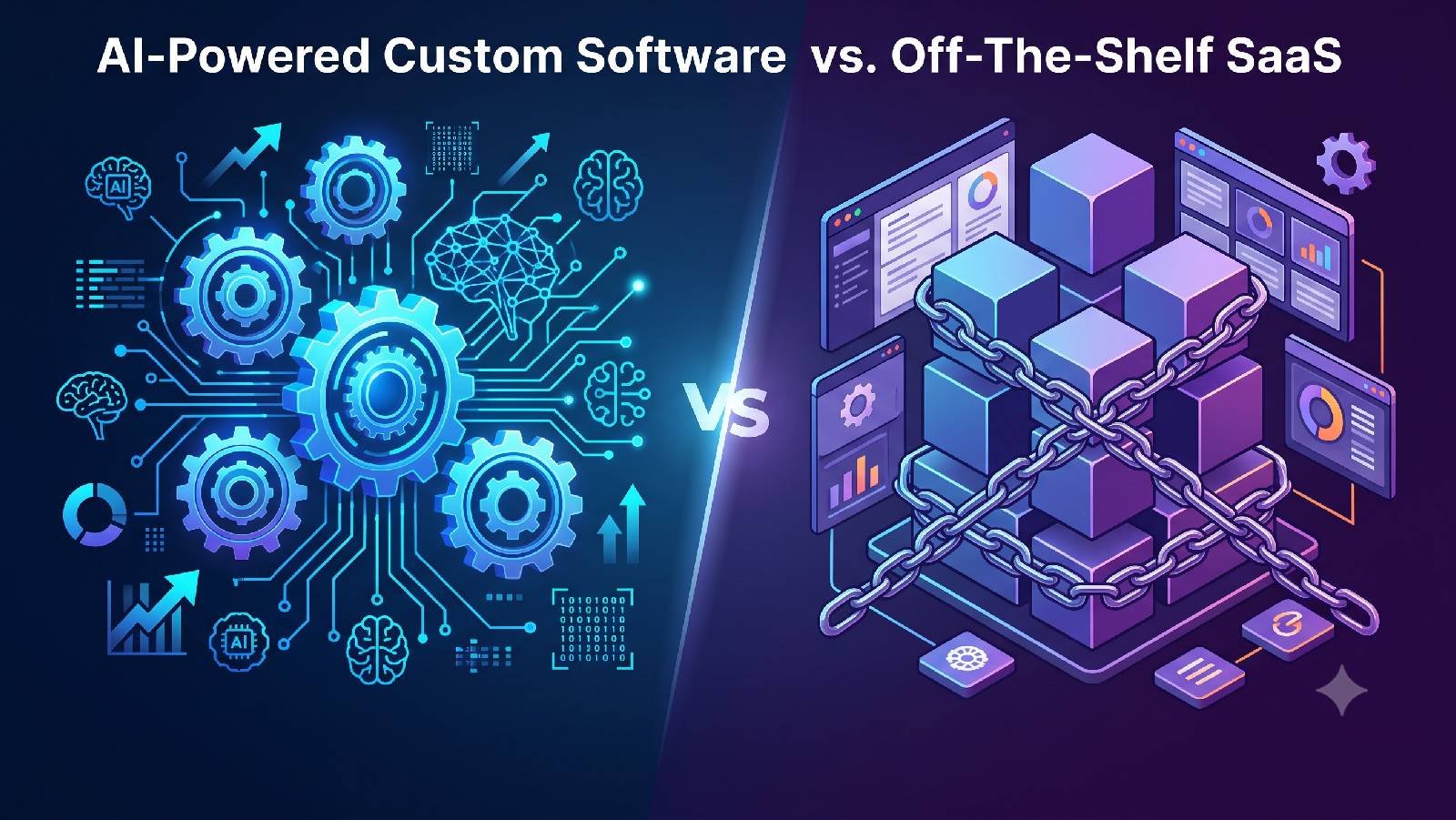
Off-the-shelf SaaS gets you started fast, but AI-powered custom software delivers unmatched control and ROI. Here is how to evaluate the strategic, technical, and financial trade-offs to future-proof your digital operations.
Every growing company reaches a crossroads when its technology stack begins to creak under operational scale. In the early stages, purchasing an off-the-shelf Software-as-a-Service (SaaS) subscription is the obvious, sensible default. It deploys instantly, requires zero upfront development capital, and handles standard business chores right out of the box.
However, enterprise software consumption has undergone a massive shift. With SaaS subscription inflation compounding at 8% to 12% annually, hidden usage-based AI credit fees, and enterprises managing hundreds of disconnected apps, many leadership teams are hitting "SaaS fatigue". When standard applications force teams to adapt their core workflows to rigid software—rather than the software adapting to the business—off-the-shelf platforms cease being an accelerator and become an operational bottleneck.
This is where AI-powered custom software changes the strategic equation. Below, we break down the operational, architectural, and financial trade-offs to help decision-makers evaluate whether to build or buy.
1. The Architectural Shift: Generic Tools vs. Context-Aware AI
Traditional off-the-shelf SaaS operates on multi-tenant architecture designed to serve the broad common denominator of thousands of companies. When SaaS vendors layer AI features onto these platforms, they typically arrive as generic wrappers—basic autocomplete widgets, standard chatbots, or surface-level summaries that lack internal business context.
In contrast, bespoke AI software is designed directly around an organisation's proprietary datasets, internal logic, and specific compliance guardrails:
- Domain-Specific Agents: Instead of disjointed tools requiring manual handoffs, custom AI systems deploy autonomous micro-agents directly inside your database layer to execute multi-step workflows.
- Data Sovereignty and Model Control: Standard SaaS platforms frequently process business data across multi-tenant servers or third-party API aggregators. Custom systems keep all embeddings, vector indexes, and fine-tuned models inside a private, zero-trust cloud VPC.
- Deep Process Alignment: Off-the-shelf software forces employees to execute workarounds using messy spreadsheets and third-party glue software. Bespoke platforms model business processes down to the exact edge case.
2. Feature-by-Feature Comparison Matrix
| Strategic Vector | Off-The-Shelf SaaS | AI-Powered Custom Software |
|---|---|---|
| Initial Deployment Speed | Days to weeks; turnkey onboarding. | 8 to 16 weeks for production MVP. |
| Upfront Capital Expense | Low (initial setup & onboarding fee). | Moderate to high (engineering design & build). |
| Pricing Trajectory | Escalates per user seat and per API token call. | Predictable cloud hosting & infrastructure compute. |
| Data Privacy & Compliance | Third-party cloud storage; shared models. | Strict data isolation, VPC hosting, custom governance. |
| System Integrations | Restricted to vendor APIs and webhooks. | Limitless; native integration with internal ERP/CRMs. |
| Workflow Flexibility | Rigid; team adapts to vendor’s UI/UX. | 100% bespoke to team workflows and automation goals. |
| Balance Sheet Impact | Pure recurring operating expense (OpEx). | Capitalized balance-sheet IP asset (CapEx). |
3. Financial Analysis: 5-Year Total Cost of Ownership (TCO)
While SaaS presents a lower barrier to entry, its compounding costs often cross the break-even threshold faster than many CFOs anticipate. Consider a mid-market enterprise with 100 internal users deploying a core workflow platform:
The SaaS Cost Trajectory
- Seat Licensing: 100 seats at $150/user/month = $180,000/year.
- AI Add-Ons & Overages: Usage-based token packs and premium agent tiers adding $30,000/year.
- Annual Contract Price Escalations: Vendor increases prices by an average of 10% year-over-year.
- Total 5-Year Outlay: Approximately $1,280,000+ in operational expenditure with zero residual equity.
The Custom AI Software Trajectory
- Initial Engineering & Architecture: $150,000 one-time build.
- Ongoing Maintenance & Updates: Budgeted at 15% to 20% of initial build (~$25,000 to $30,000/year).
- Private Cloud Infrastructure & Compute: ~$18,000/year on dedicated cloud instances.
- Total 5-Year Outlay: Approximately $380,000 to $420,000, delivering a 65%+ reduction in long-term technology spend.
4. When to Buy vs. When to Build
The choice between SaaS and custom development is not binary. The most resilient enterprises apply a clear rule of thumb: Rent your utilities, build your core competitive edge.
When to Buy Off-The-Shelf SaaS:
- Commodity Back-Office Workflows: Functions like standard accounting, payroll, and team messaging do not differentiate your business. Buying standard SaaS is the most cost-effective path.
- Speed-to-Market is the Only Metric: If an operational hypothesis needs validation within two weeks, adopting a SaaS product provides immediate market feedback.
- Small Team Size: If your active user base is under 15–20 seats, the recurring subscription remains cheaper than engineering custom interfaces.
When to Build Custom AI Software:
- The Software Drives Your Revenue Engine: If the workflow directly powers how you manufacture, price, consult, or deliver services, generic SaaS makes your output identical to competitors.
- Subscription Fatigue & Seat Penalties: When team growth punishes your margins through bloated per-seat licenses, a unified custom portal removes user limits entirely.
- Complex, Regulated Data Pipelines: Healthcare, financial services, and supply chains often handle proprietary data that cannot be routed through public third-party SaaS models under strict compliance rules (HIPAA, SOC 2, GDPR).
- Proprietary AI Moats: When you possess proprietary historical data, embedding retrieval engines or fine-tuning models inside custom software builds long-term enterprise valuation.
5. Strategic Takeaway
Off-the-shelf SaaS remains an essential driver for business utility. But as organisations scale, relying entirely on rented software limits your operational speed and builds value on someone else's balance sheet.
By taking control of mission-critical systems through tailored, AI-enabled software architectures, enterprises replace uncontrollable subscription costs with permanent operational leverage, airtight security, and proprietary IP that appreciates alongside the business.