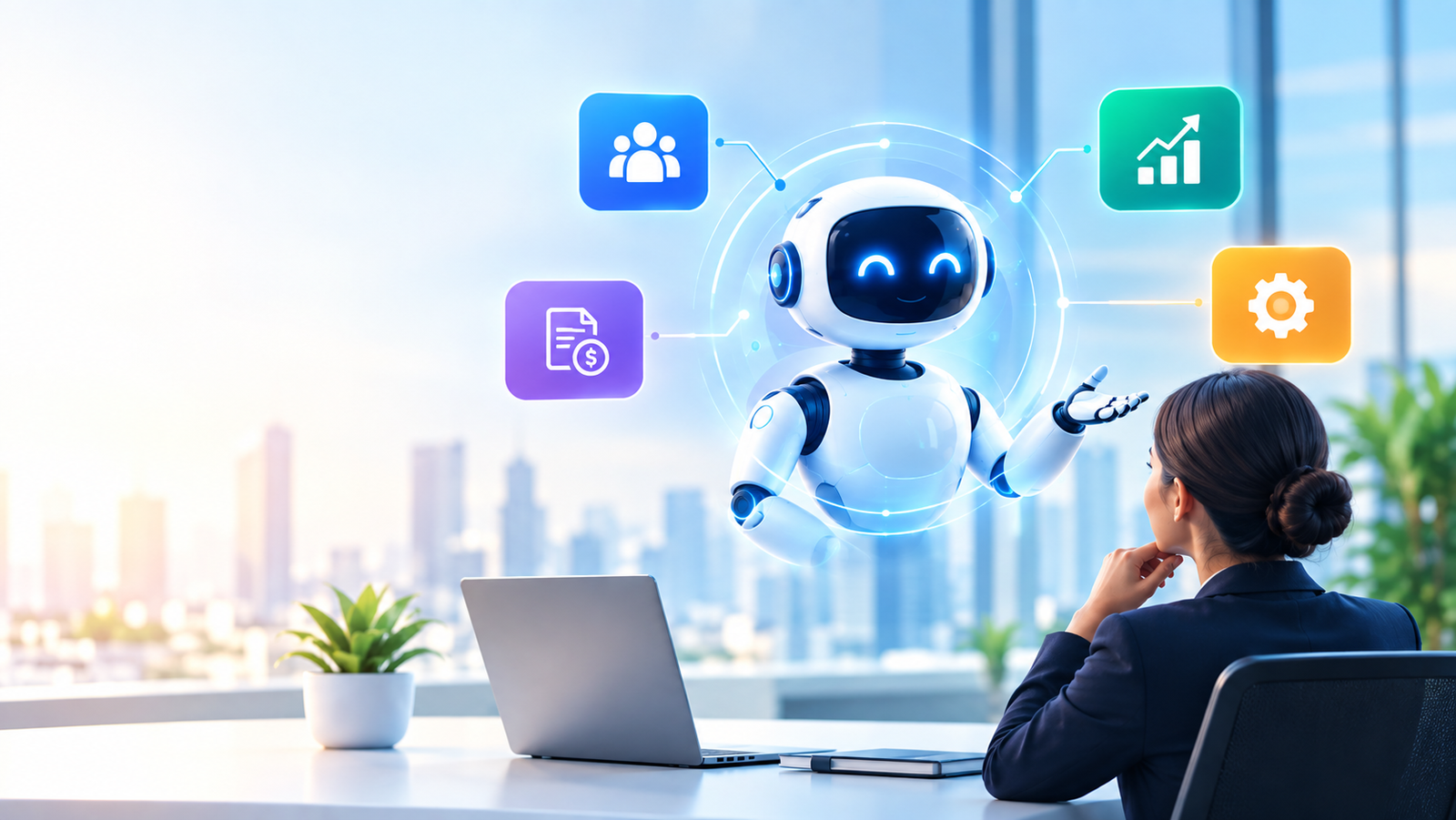
Artificial intelligence is moving beyond chatbots and simple automation. A new generation of AI agents in business is changing how organizations manage customers, employees, workflows, data and everyday operations.
Traditional business software generally waits for a person to enter information, select an option or initiate a workflow. AI agents can take a more proactive approach. Depending on how they are designed and authorized, they can understand business information, determine the next step, use connected systems and complete multi-step tasks with limited human intervention.
This shift is particularly important for CRM, HRMS, payroll and business operations, where employees spend significant amounts of time handling repetitive processes.
For businesses looking to improve productivity without continuously increasing administrative workload, AI agents could become an important part of the next generation of business software.
What Are AI Agents in Business?
An AI agent is a software system designed to understand a goal, process information, make decisions within defined boundaries and perform actions using connected tools or applications.
A traditional automation might follow a fixed rule:
If a customer submits a form, send an email.
An AI-powered agent can potentially handle a broader workflow:
Identify a new lead, understand its requirements, check the CRM history, prioritize the lead, prepare a personalized response and create a follow-up task.
The key difference is that traditional automation usually follows predefined instructions, while an AI agent can handle more flexible situations based on context and available information.
However, AI agents should not be treated as completely autonomous replacements for employees. Businesses need appropriate permissions, monitoring, security controls and human oversight, particularly when agents are making decisions that affect customers, employees or financial processes.
Why Are AI Agents Becoming Important for Businesses?
Businesses generate enormous amounts of information every day.
Sales teams manage leads and customer conversations. HR teams manage employee records and requests. Finance teams process invoices and payments. Operations teams coordinate multiple workflows.
Many of these activities involve repetitive tasks.
AI agents can help organizations connect information and workflows across different business systems.
Some potential benefits include:
- Reduced repetitive administrative work
- Faster response times
- Improved workflow efficiency
- Better access to business information
- More personalized customer interactions
- Automated follow-ups and reminders
- Improved employee self-service
- Better use of existing business data
- Faster identification of operational issues
The biggest opportunity is not simply using AI to generate text. It is using AI to complete useful business workflows.
AI Agents in CRM
CRM systems are one of the areas where AI agents can have a significant impact.
Traditional CRM platforms primarily help businesses store customer information, track opportunities and manage sales activities. AI can add another layer of intelligence by helping teams interpret information and automate actions.
1. Lead Qualification
An AI agent can analyze information associated with incoming leads and help categorize them according to predefined business criteria.
For example, it could consider:
- Company size
- Industry
- Customer requirements
- Previous interactions
- Engagement level
- Purchase intent
- The sales team can then focus its attention on leads that require human interaction.
2. Automated Follow-Ups
Sales representatives often lose opportunities because follow-ups are delayed.
An AI agent connected to a CRM could identify leads requiring follow-up, prepare a relevant message and create a task—or, where appropriate and authorized, send the communication automatically.
This can help sales teams maintain consistent customer engagement.
3. Customer Support
AI agents can also assist customer service teams.
Instead of simply answering frequently asked questions, an agent can potentially:
- Understand the customer's request.
- Retrieve relevant customer information.
- Check previous interactions.
- Identify the appropriate workflow.
- Resolve the request or escalate it to an employee.
This creates a more connected customer experience.
4. Sales Intelligence
AI can analyze CRM information to identify patterns.
For example, businesses may use AI to identify:
- Leads that have become inactive
- Customers showing reduced engagement
- Deals requiring attention
- Frequently requested products or services
- Common customer problems
- This allows sales managers to spend less time manually reviewing CRM records.
AI Agents in HRMS
Human Resource Management Systems contain another large collection of repetitive workflows.
Employees frequently need information about leave, attendance, policies, documents, payroll and internal processes.
AI agents can make HRMS platforms more conversational and automated.
Employee Self-Service
Instead of searching through multiple HR pages, employees could ask questions such as:
How many leave days do I have?
What is the company's leave policy?
Show my attendance for this month.
How can I download my salary slip?
An AI agent connected to the HRMS could retrieve the appropriate information based on the employee's permissions.
This can reduce the number of repetitive questions handled manually by HR teams.
HR Workflow Automation
AI agents can also support HR workflows such as:
- Employee onboarding
- Document collection
- Interview scheduling
- Leave management
- Employee queries
- Policy information
- Exit processes
- Internal notifications
For example, during onboarding, an AI-powered workflow could coordinate multiple steps such as collecting documents, notifying relevant departments and creating tasks for IT and HR.
Human approval can remain part of the workflow whenever a decision requires it.
AI Agents in Payroll
Payroll is a sensitive business function because it involves employee compensation and financial information.
AI can assist payroll teams, but organizations should apply particularly strong controls around access, validation and approvals.
Potential applications include:
Payroll Data Validation
AI systems can help identify unusual payroll information, missing data or inconsistencies for human review.
Employee Payroll Assistance
Employees could ask questions about:
- Salary slips
- Payroll dates
- Tax-related documents
- Attendance impact
- Leave-related payroll information
The system can provide information based on authorized employee data.
Payroll Workflow Monitoring
An AI agent could monitor workflow status and notify authorized payroll administrators when an action is pending or information requires review.
The goal should not be to remove human accountability from payroll. Instead, AI can help payroll professionals spend less time on repetitive administrative tasks and more time reviewing exceptions and important decisions.
AI-Powered Business Operations
The impact of AI agents extends beyond CRM and HRMS.
Almost every department has repetitive workflows that can potentially be improved through intelligent automation.
Conclusion
AI agents in business represent an important evolution in business automation.
From CRM and HRMS to payroll and operational workflows, AI agents can help organizations reduce repetitive work, improve responsiveness and make better use of their business data.
However, successful AI adoption is not simply about adding an AI chatbot to existing software. Businesses need the right combination of AI, automation, integrations, data security and human oversight.
Companies that begin by identifying practical, measurable use cases can build a foundation for broader AI adoption over time.
The future of business technology is not necessarily about replacing people with AI. It is increasingly about giving people intelligent digital systems that can handle routine work, surface useful information and help employees focus on higher-value activities.
AI agents are becoming a new layer of business software - and organizations that learn how to use them responsibly can unlock new possibilities across CRM, HRMS and business operations.